How did the gear perform on rain-soaked trails?
OTT 2026 Yeongnam Alps Gear Log / Rainy-weather hiking gear through 123 participant responses
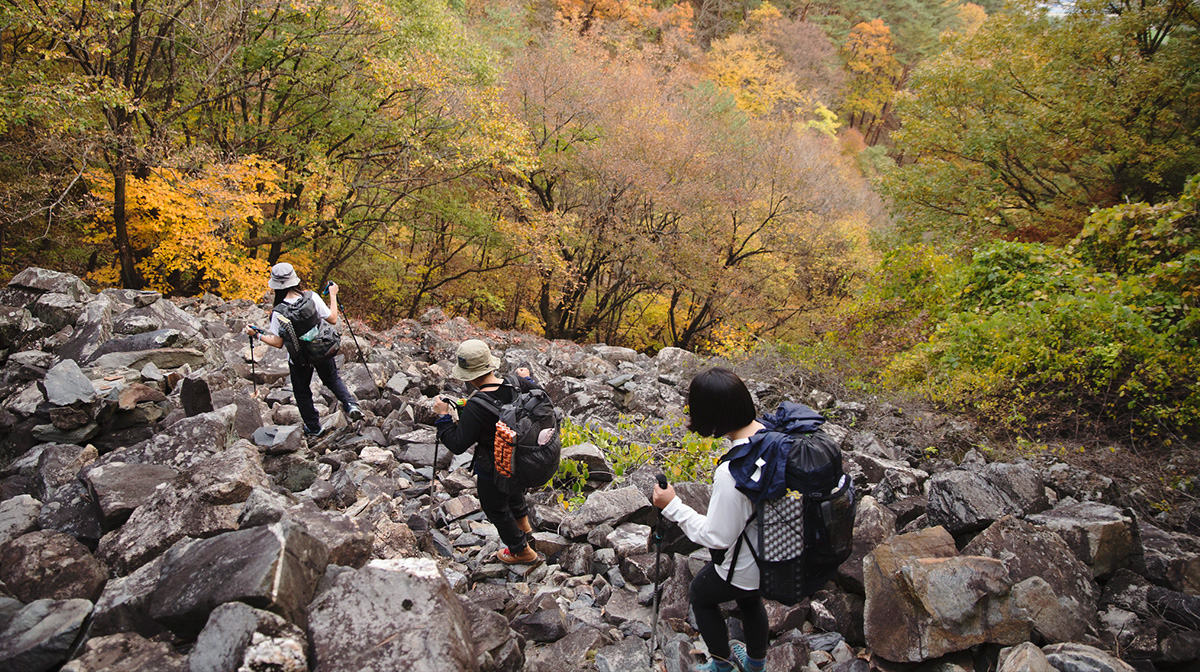
On a trail where rain persists, the reasons for choosing equipment meet the reality of using it. The weight of a pack, moisture inside a jacket, putting wet shoes back on: the 123 responses in the OTT 2026 Yeongnam Alps Gear Log document the experiences of participants who spent extended periods walking in the rain.
Every respondent reported walking in the rain for at least 3 hours. This record is about more than product rankings. It is also worth examining which equipment people used and which problems that equipment did not resolve.
01 / PACK & PACE
Lightweight choices do not eliminate the weight at the start
A backpacking-oriented equipment style was the most common response, with 70 (56.9%), followed by ultralight, centered on lighter gear, with 44 (35.8%). Starting pack weights, including food and water, were at least 9kg in 47 responses (38.2%) and at least 7kg but below 9kg in 37 (30.1%). Together, these ranges account for 84 responses, or 68.3% of the total.
Equipment style and weight were separate questions. These aggregate figures cannot establish how many kg were actually carried by participants who described their style as ultralight. What they do show is that, regardless of the style selected, many respondents started with at least 7kg.
Footwear choices were trail-running shoes in 59 responses (48.0%), mid- or high-cut hiking boots in 43 (35.0%), and low-cut hiking shoes in 21 (17.1%). Actual use of trekking poles was reported in 109 responses (88.6%). These figures describe participants’ choices; they do not establish the superiority of any footwear type or equipment.
02 / RAINWEAR
Wearing a jacket and staying comfortable are different things
Rain-jacket use was reported in 101 responses, or 82.1% of the total. Rain pants or rain skirts were used in 76 responses (61.8%). Although upper- and lower-body rainwear use differed, these aggregates do not identify individual equipment combinations.
There were 99 responses to the question on rain-jacket performance. The most frequent answer was “kept rain out, but the inside became wet with sweat or moisture,” with 38 responses (38.4%). Rain entering along with internal moisture was reported in 26 responses (26.3%), and rain entering from outside in 16 (16.2%).
Responses reporting rain ingress, internal moisture, or both total 80 (80.8%). The denominator also includes 11 “difficult to judge” responses. “Both rain and internal moisture were managed well” accounted for 8 responses (8.1%).
The 80.8% figure is not a product defect rate or a waterproofing failure rate. These are experiences reported by participants using different equipment under different conditions. The responses highlight the need to consider not only protection from external rain, but also the management of sweat and moisture generated inside a rain jacket.
03 / KEEPING THINGS DRY
Rain outside the body, waterproofing inside the pack
Umbrella use was reported in 40 responses (32.5%), and poncho or disposable raincoat use in 30 (24.4%). These were separate questions and may overlap with rain-jacket use. The figures cannot be added together as counts of distinct users.
An internal pack liner or plastic bag was the most common primary method of protecting packs and their contents, with 43 responses (35.0%). Combining at least two methods accounted for 31 responses (25.2%), and pack rain covers for 23 (18.7%).
Participants chose various waterproofing methods, from covering the outside of a pack to protecting items separately inside. During prolonged exposure to rain, how the contents are protected and managed matters alongside the waterproof performance of the pack itself.
04 / AFTER THE RAIN
The inconvenience after getting wet is part of the experience
Feedback recorded not only wet clothing and shoes, but also the inconvenience of storing wet equipment, additional weight, and putting wet shoes back on at camp. Some responses also mentioned smartphone touchscreen malfunctions and charging problems.
“When storing wet equipment, the increase in pack weight caused by the equipment getting wet.”
Translation of 1 original response to “What was most inconvenient about using gear in the rain?”
Free-text responses mentioned rain pants and rain skirts, umbrellas, footwear, and waterproof storage among the items people would add or change for their next rainy hike. These are individual examples, not a new ranking based on the frequency of themes. Even after experiencing the same rain, participants differed in what they wanted to change next.
This gear log leaves several practical questions. How was moisture inside jackets managed while walking? How were spare clothes protected inside packs? What was most inconvenient about organizing wet equipment and getting moving again?
Expectations when choosing equipment do not always match actual experience. In prolonged rain especially, waterproofing needs to be considered alongside moisture management, storage methods, and the process of using wet equipment again.
We hope this record provides a useful reference for reconsidering both equipment choices and how equipment is used when preparing for the next hike.
How to read the data in this article
This article is based on the original HTML aggregation of 123 responses to administrator survey ID 4, obtained on 2026-11-2. Surveys from other events were not included. The original did not provide the total number of participants or the response rate, so the results have not been generalized to all participants or hikers overall.
Percentages were calculated using the denominator for each question. Blanks in conditional questions may represent non-use, a question not shown, or an unanswered question; they were not all treated as non-use. Brand mentions use valid responses to the relevant question as their denominator, and totals may exceed 100% because multiple brands could be named. These figures differ from ownership or actual-use rates.
The original 99 standardized-name groups, model codes, and distinctions by generation, capacity, size and material were retained. Original free-text responses and standardized names are preserved in a separate full statistics archive. Testimonials quoted in the article describe individual participants’ experiences, not the proportion of all opinions.